When a Freelance Opportunity Becomes a Risk: Social Engineering & International Clients

A freelance opportunity can look completely ordinary: a professional introduction, a clear assignment, an agreed fee. The risk may appear later—when a client asks you to make a purchase, disclose sensitive information, install software, or act immediately.
That is where social engineering becomes important.
Social engineering is not primarily about breaking through a technical barrier. It is about persuading a person to take an action that benefits the attacker. CISA describes phishing as a form of social engineering in which a threat actor may impersonate a trusted person or organization to obtain sensitive information or network access.
For freelancers working with unfamiliar or international clients, the practical lesson is simple:
verify the request, not just the opportunity.

The scale of the problem
Online fraud is not a niche problem. The FBI's Internet Crime Complaint Center recorded 880,418 complaints and more than $12.5 billion in reported potential losses in 2023. Its 2024 reporting shows complaint-reported losses rising further, to $16.6 billion. These figures cover many forms of internet crime, not freelance scams specifically, so they should not be interpreted as a measure of freelancer fraud. They do, however, demonstrate the broader financial environment in which remote workers operate.
The international dimension matters too. In its Business Email Compromise reporting, the FBI says such schemes had been reported across 186 countries, with more than 140 countries receiving fraudulent transfers in the data it analyzed through 2023. Cross-border work does not make a client fraudulent, but it can make independent verification and recovery more complicated.
How a risky request can escalate?
Social engineering often works because the individual request does not initially appear dramatic.
A useful way to understand the pattern is:
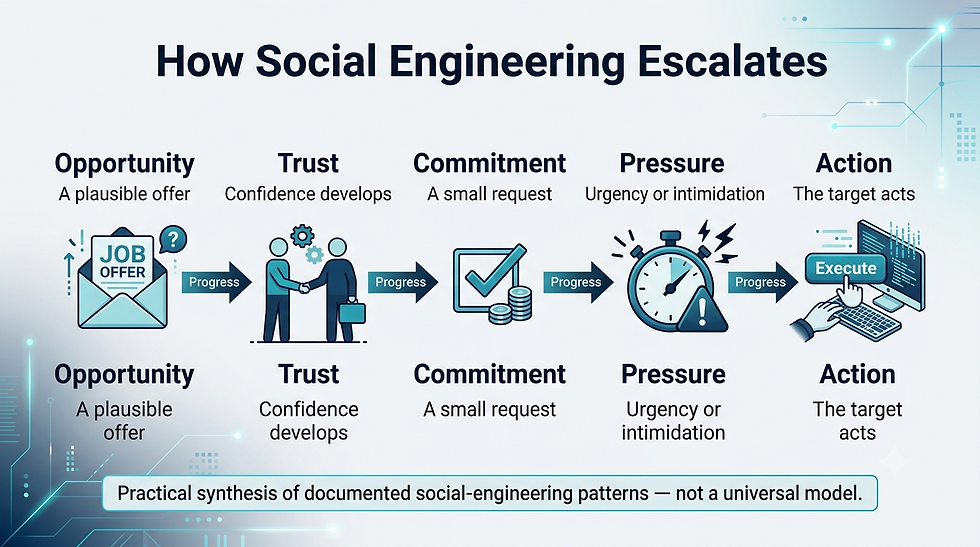
Opportunity → Trust → Commitment → Pressure → Action
This is a practical synthesis of documented social-engineering patterns—not a universal five-stage model.
A seemingly legitimate opportunity establishes context. A professional conversation builds confidence. Then comes a request: purchase something, pay a fee, provide information, click a link, or install software.
The commitment can make the next request feel easier to accept. Pressure then reduces the time available for independent verification.
The FBI has documented work-from-home scams in which victims were offered apparently simple jobs and then told to make payments to unlock further work. Its guidance is blunt:
Never send money to an alleged employer.
The FTC similarly warns about employment scams involving upfront payments for equipment or other expenses. In one documented scheme, supposed new hires were directed to purchase equipment from a preferred supplier and promised reimbursement; the equipment never arrived.
Five signals worth stopping for
🚩 1. You must spend money to receive work
A request to pay before earning should trigger verification. The FTC specifically identifies upfront payment as a warning sign in employment scams.
🚩 2. A client wants unnecessary access
Legitimate remote-access tools have legitimate uses. The risk arises when an unfamiliar party asks you to install software or provide access without a clear, independently verified technical reason. The FTC has documented scams in which remote access was used to obtain personal and financial information.
🚩 3. The client's identity cannot be independently verified
A missing website does not prove fraud. Neither does a generic email address.
But when several verification signals are absent, pause before sharing information, spending money, or accepting unusual instructions. The FTC recommends independently checking the company and searching for complaints or scam reports before committing to an opportunity.
🚩 4. You are pushed to act immediately
Urgency is a recognized social-engineering technique.
CISA specifically warns that phishing can create a sense of urgency or alarm to manipulate recipients into taking action.
🚩 5. Questioning the request produces pressure
A professional disagreement is normal.
Escalating guilt, intimidation, accusations, or threats are different.
When pressure replaces evidence, pause rather than comply.
🚩🚩🚩One more risk: platform rules
Freelancers also need to check whether the requested activity is permitted by the platform involved.
For example, Amazon states that customer reviews exchanged for compensation can violate its Community Guidelines.
That creates a separate risk from financial fraud:
you can potentially lose account access or damage your professional reputation by accepting work that conflicts with a platform's rules.
The 60-second freelancer safety test
Before accepting an unusual client request, ask:
WHO? Can I independently verify the client?
WHAT? Is the requested task clearly defined?
WHY? Why do I need to spend money, install software, or provide this information?
WHERE? Is the request happening through a trusted platform or independently verifiable channel?
POLICY? Does the requested activity comply with the platform's rules?
WHAT IF? What happens if the promised reimbursement or payment never arrives?
PRESSURE? Am I being pushed to act before I can verify the request?
If several answers raise concerns, stop and verify before proceeding.
Digital safety for freelancers is not about assuming every unfamiliar client is dishonest. It is about refusing to let a promising opportunity remove your normal safeguards.
The safest freelance decision is sometimes not "yes" or "no." It is simply: "I'll verify that first."


Comments