BookSirens vs. NetGalley: Which ARC Platform Is Better for Indie Authors? A Data-Driven Comparison (2026)


Launching a book is only half the battle. For most indie authors, the real challenge begins after publication—finding readers who will leave honest reviews, build early momentum, and increase discoverability on platforms like Amazon and Goodreads.
Among the many Advance Reader Copy (ARC) distribution services available today, BookSirens and NetGalley remain two of the most recognized names. However, they are built on very different philosophies. NetGalley focuses on industry reach and institutional visibility, while BookSirens emphasizes affordability, automation, and review efficiency.
As someone (Top 5% in BookSirens) who has reviewed books through both platforms, I wanted to compare them using a mixed-method approach—combining quantitative market data with qualitative reviewer experience. Rather than asking which platform is "better," this article explores which platform is better for different publishing goals.
BookSirens vs. NetGalley at a Glance
Feature | NetGalley | BookSirens |
Active Audience | 700,000+ members worldwide | 30,000–50,000+ active readers |
Primary Audience | Librarians, booksellers, educators, reviewers, media | Readers, bloggers, Bookstagrammers, influencers |
Standard Pricing | $575 for a 6-month listing | $10 submission fee + $2 per reader download |
Alternative Pricing | IBPA Co-op from $199 | $100/year Author Plan |
Average Review Completion | ~38% (eBooks, independent estimates) | ~75% (official platform data) |
Best For | Industry exposure | Cost-efficient review generation |
Market Perspective: Reach vs. Return on Investment

Choosing an ARC platform is ultimately a marketing decision. The ideal platform depends on three factors:
your publishing budget,
your target audience,
and your expected return on investment (ROI).
NetGalley: Built for Industry Visibility
NetGalley has become the industry standard for advance digital review copies. According to NetGalley Insights, the platform now serves more than 700,000 members, including librarians, educators, booksellers, journalists, reviewers, and publishing professionals.
This extensive professional network explains why many traditional publishers—including the "Big Five" (Hachette, Penguin Random House, Simon & Schuster, HarperCollins, and Macmillan)—continue to rely on NetGalley before major book launches.
If your objective is to secure librarian recommendations, bookstore attention, trade media exposure, or educational adoption, NetGalley offers a level of institutional visibility few competitors can match.
The trade-off, however, is cost.
A standard six-month listing currently costs $575, although Independent Book Publishers Association (IBPA) members may access discounted co-op pricing beginning around $199. Optional promotional features such as category spotlights increase campaign costs even further.
BookSirens: Built for Efficient ARC Campaigns
BookSirens approaches ARC distribution differently.
Instead of charging a large upfront listing fee, authors pay a $10 submission fee (only after approval) and $2 for each reader download. Authors can also establish spending limits, making campaign budgeting significantly more predictable.
For prolific authors, the annual Author Plan replaces per-download pricing with a flat yearly subscription.
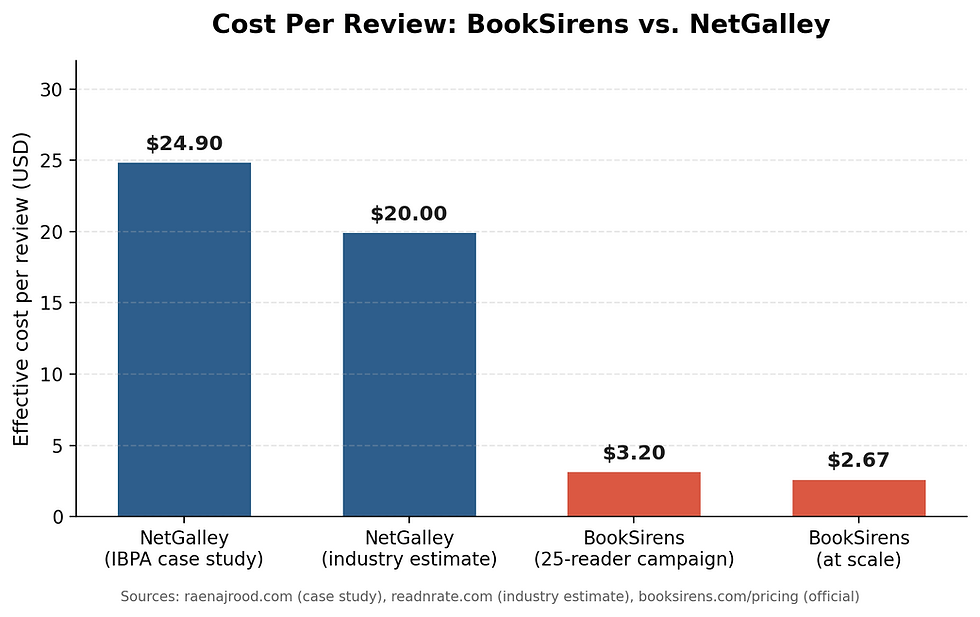
Cost Per Review: The Metric That Actually Matters
Many authors focus exclusively on listing price.
A more meaningful metric is cost per completed review.
Independent case studies demonstrate this difference clearly.
One documented NetGalley campaign costing $199 generated 55 downloads but only 8 completed reviews, resulting in an estimated cost of approximately $24.90 per review.
The same author's BookSirens campaign generated 12 reviews from only 17 downloads, producing an estimated review cost of approximately $8.30 per review.
When BookSirens' published 75% review completion rate is combined with its pricing model, effective review costs can decline even further as download volume increases.
This pricing structure particularly benefits self-published authors and boutique presses working within limited marketing budgets.
Although individual campaigns naturally vary, these examples illustrate an important distinction:
NetGalley sells reach. BookSirens sells efficiency.
Review Completion Rates
One of the strongest quantitative differences between the platforms is review completion.
BookSirens publicly reports a site-wide review completion rate of approximately 75%, achieved through automated reminder systems, reviewer accountability, and download tracking.
NetGalley does not publish an official overall completion rate. However, multiple independent author case studies estimate completion rates for self-published eBooks around 33–38%, while audiobook campaigns frequently perform substantially better.
This does not necessarily indicate weaker reviewer engagement.
Instead, NetGalley's much broader audience includes librarians, educators, journalists, booksellers, and reviewers who often request significantly larger numbers of titles simultaneously.
Reviewer Experience: A Qualitative Perspective

Numbers tell only part of the story.
Having reviewed books on both platforms, I noticed meaningful differences in reviewer culture.
Reviewing on NetGalley
NetGalley reviewers generally approach books with an analytical mindset.
Many reviewers are librarians, educators, booksellers, experienced bloggers, or industry professionals whose evaluations often extend beyond entertainment value to include market positioning, audience suitability, and editorial quality.
The platform also encourages accountability through its well-known Feedback Ratio, motivating reviewers to maintain consistent review completion rates.
Reviewing on BookSirens
BookSirens creates a noticeably different reviewing environment.
Its recommendation algorithm matches reviewers primarily according to genre preferences and previous reviewing behavior, producing highly targeted reading experiences.
Most reviewers appear to approach books primarily as enthusiastic readers rather than trade professionals.
Constructive criticism certainly exists, but discussions often emphasize reader enjoyment, pacing, characterization, and overall reading experience rather than industry positioning.
Cross-Posting and Reader Visibility
Another practical difference involves review distribution.
BookSirens actively encourages reviewers to cross-post reviews to Amazon and Goodreads after publication, helping authors accumulate visible retail reviews.
NetGalley also supports review sharing across Goodreads, blogs, retailer platforms, and media outlets, although reviewer behaviour varies considerably depending on reviewer type.
For authors focused primarily on Amazon visibility, BookSirens' reminder system may provide an additional advantage.
Which Platform Should You Choose?
Choose NetGalley if:
You want librarian, educator, or bookstore exposure.
Your publisher values industry credibility.
You're launching a flagship title.
Budget is less important than institutional reach.
Choose BookSirens if:
You're an indie or self-published author.
You want predictable marketing costs.
Your goal is maximizing review volume.
You publish multiple books annually.
Return on investment is your primary concern.
Can Authors Use Both?
Absolutely.
Many experienced indie authors combine both platforms strategically.
BookSirens generates affordable reader reviews and Amazon visibility across multiple releases.
NetGalley becomes a premium marketing investment for flagship launches requiring broader publishing industry exposure.
Rather than competing directly, the platforms often complement each other.
Final Thoughts
The debate between BookSirens vs. NetGalley is less about identifying a single winner and more about understanding different publishing objectives.
Quantitatively, BookSirens currently offers a more economical route to reader reviews, with lower entry costs and a higher reported review completion rate.
Qualitatively, NetGalley's unmatched network of librarians, booksellers, educators, and publishing professionals continues to provide strategic advantages for authors seeking wider industry recognition.
As a reviewer on both platforms, I've found valuable books through each. Both contribute meaningfully to the publishing ecosystem—they simply solve different problems.
Ultimately, the best ARC strategy depends not only on your budget but also on who you want reading your book first.
Explore More Author Resources
Looking for trusted tools to support your publishing journey?
Explore my Author Resources page, where I share recommended platforms, publishing resources, and editorial services for indie authors and small publishers.
References
This article incorporates information from official platform documentation, pricing pages, NetGalley Insights, BookSirens support documentation, independent author case studies, and publishing industry analyses. Pricing and platform statistics may change over time; authors should verify current information before launching a campaign.
BookSirens official pricing page (fetched live) — https://booksirens.com/pricing
NetGalley official pricing/checkout page (fetched live) — https://www.netgalley.com/packages/order
NetGalley "How It Works" — https://www.netgalley.com/tour
Publishers Weekly, "The Savvy Self-Publisher's Guide to NetGalley" — https://www.publishersweekly.com/pw/by-topic/authors/pw-select/article/68517-the-savvy-self-publisher-s-guide-to-netgalley.html
Kindlepreneur, NetGalley Review — https://kindlepreneur.com/netgalley-review/
Reedsy Discovery, "NetGalley: How Does It Work for Reviewers?" — https://reedsy.com/discovery/blog/netgalley-for-reviewers
eBookBuilders, "Navigating NetGalley, BookSirens, and Beyond" — https://ebookbuilderspro.com/netgalley-booksirens-guide/
Read & Rate, "NetGalley Alternatives: 7 Better ARC Platforms (2026)" — https://www.readnrate.com/blog/netgalley-alternatives-indie-authors
Raena Rood, "NetGalley VS BookSirens: Which Is Better For Indie Authors?" (case study with real download/review numbers) — https://raenajrood.com/netgalley-vs-booksirens-which-is-better-for-indie-authors/
Shawn P. B. Robinson, "BookSirens for Reviews!" — https://shawnpbrobinson.com/booksirens-for-reviews/
Hayley Reese Chow, "ARC Sites: NetGalley, BookSirens, or Hidden Gems?" — https://hayleyreesechow.com/2021/08/02/arc-sites-netgalley-booksirens-or-hidden-gems/
TCK Publishing, BookSirens Review — https://www.tckpublishing.com/booksirens-review/
Melanie Rockett, "Review of BookSirens ARC Service" — https://melanierockett.com/review-of-booksirens-arc-service/
Goodreads discussion thread on BookSirens (reviewer-side commentary) — https://www.goodreads.com/topic/show/22188324-booksirens
G2, NetGalley Reviews — https://www.g2.com/products/netgalley/reviews
BookSirens, "The Easiest Way to Become a Book Reviewer" — https://booksirens.com/become-a-book-reviewer


Comments